
Introduction
One of the most elementary and easy-to-overlook circuit component is the switch. Switches don’t require any fancy equations to evaluate. All they do is select between an open circuit and a short circuit. Simple.
What is a Switch?
A switch is a component which controls the open-ness or closed-ness of an electric circuit. They allow control over current flow in a circuit (without having to actually get in there and manually cut or splice the wires). Switches are critical components in any circuit which requires user interaction or control.
A switch can only exist in one of two states: open or closed. In the off state, a switch looks like an open gap in the circuit. This, in effect, looks like an open circuit, preventing current from flowing.
In the on state, a switch acts just like a piece of perfectly-conducting wire. A short. This closes the circuit, turning the system “on” and allowing current to flow unimpeded through the rest of the system.
A circuit diagram with an LED, resistor, and a switch. When the switch is closed, current flows and the LED can illuminate. Otherwise no current flows, and the LED receives no power.
There are tons and tons of switches out there: toggle, rotary, DIP, push-button, rocker, membrane, … the list just goes on and on. Each of those switch types has a set of unique characteristics to differentiate it from others. Characteristics like what action flips the switch, or how many circuits the switch can control. Next up, we’ll go over some of the more basic switch characteristics.
Electrical Specifications
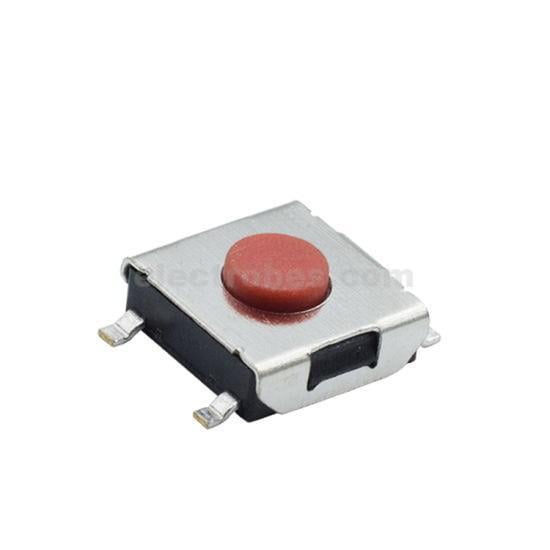
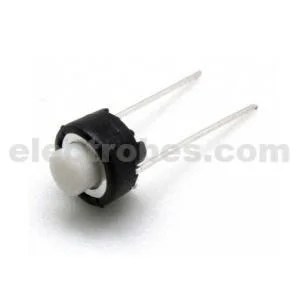
Electrical: 50,000 cycles for 160gf
Rating: 50mA/12VDC
Contact Resistance: 100mΩ max.
Insulation Resistance: 100MΩ min., at 500VDC
Dielectric Strength: 250 VAC / 1 minute
Mechanical Specifications
Operation Force: 160±50gf Brown (N)
Stroke: 0.25+0.2/-0.1mm
Operating Temperature Range: -25°C to +70°C
Storage Temperature Range: -30°C to +80°C
Contact Arrangement: 1 pole 1 throw
Materials
Cover: Nickel silver
Contact Disc: Stainless with silver cladding
Terminal: Brass with silver cladding
Base: Nylon high temp thermoplastic, black
Stem: Nylon high temp thermoplastic, white
Adhesions Tape: Teflon

Reviews
There are no reviews yet.