
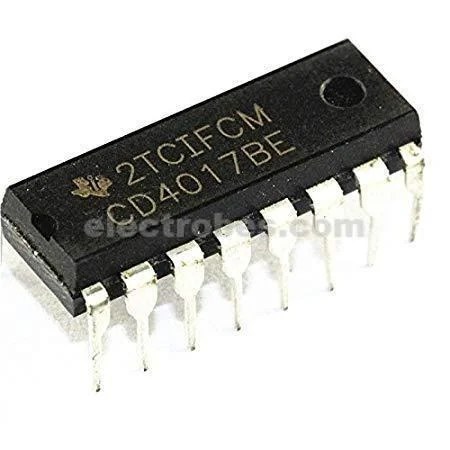
CD4017 Pin Configuration
Pin Number
Pin Name
Description
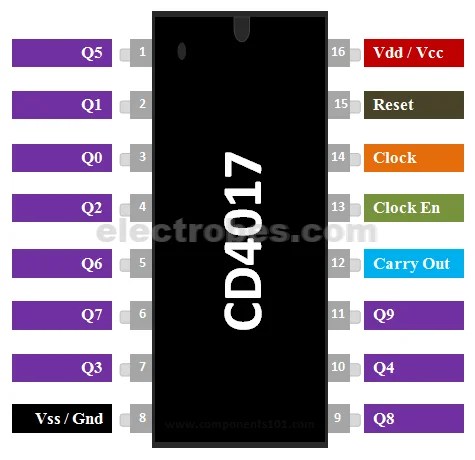
1 to 7 and 9,10,11
Output pins Q0 to Q9
These are the 10 output pins on which the counting occurs, they are not in order hence verify pin diagram above
8
Vss or Ground
Connected to the Ground of the circuit
12
Carry Out (CO)
This pin goes high after the IC counts from 1 to 10. This is used as carry while counting.
13
Clock Enable (EN)
This is an input which when made high will hold the count at the current state
14
Clock
The counting happens when this clock pulse goes high , this pin is normally connected to 555 timer or other uC to produce a pulse
15
Resets
As the name suggests this pin resets the count back to 1
16
Vdd / Vcc
Connects to the supply voltage typically +5V
Features
High speed 16 pin CMOS Decade counter
Supports 10 decoded outputs
Wide supply voltage range from 3V to 15V, typically +5V
TTL compatible
Maximum Clock Frequency: 5.5Mhz
Available in 16-pin PDIP, GDIP, PDSO packages
Applications
Alarm Systems
Remote Metering
Automotive
Medical Electronics
Running Lightings
Where to use CD4017 IC
The IC CD4017 is used for counting applications, it has the capability to turn on 10 outputs sequentially in a pre-defined time and reset the count or hold it when required. It also has the capability to indicate the status of counting using Carry pin. This is commonly used for Led chasers and other logical output projects, so if you are looking for an sequential decoded counting IC that can count up to 10 then this IC will be your right choice
How to use a CD4017 IC
The IC can work from 3V to 15V, but normally powered with +5V to the Vdd/Vcc pin and the Ground/Vss pin is connected to ground. We have 10 output pins ranging from Q0 to Q9, these pins can be connected to any load but we are using LEDs here as shown in the circuit below.
This IC will increment the count from 0 to 9 (Q0 to Q9) each time it senses a high pulse from the clock pin (pin 14). So we need a clock source to keep this IC ticking, this clock source can be a simple Timer circuit that could generate pulse or a microcontroller like Arduino, PIC etc to generate our custom pulse using I/O pins.


Reviews
There are no reviews yet.